

IEP Meeting Checklist for Florida Parents: How to Prepare for Your Child’s IEP Meeting

IEP meeting prep materials laid out on a dining table before a school meeting

Quick answer: The best IEP meeting checklist is a short one you can actually use. Review the draft IEP if you have it, gather the records that matter, decide on your top three concerns, and walk in knowing what you want the team to change, explain, or put in writing.

You do not need to know every law before the meeting starts. You do need to know your child, your questions, and the parts of the plan that still feel vague, weak, or missing.

Key takeaways

  • Go in with three priorities, not twenty scattered concerns.
  • Ask for examples, service details, and progress data when the draft sounds too general.
  • Bring your records, notes, and a written parent list so you do not forget anything in the room.
  • If something important is not clear, ask for it to be added or clarified before the meeting ends.

What to do two weeks before the meeting

Start by getting clear on why this meeting matters. Is it an annual review, an eligibility meeting, a reevaluation, or a problem-solving meeting because the current plan is not working? The answer changes what you need to bring and what you should ask.

If the school sent a draft IEP, read it slowly. Mark anything that feels too broad. Watch for goals that sound nice but do not tell you how progress will be measured. Watch for services that list minutes but do not explain where they happen, how often they happen, or what they are supposed to accomplish.

This is also a good time to re-read who creates and approves the IEP. Parents often walk into the room assuming one person has already made every decision. That is not how the process is supposed to work. The team is supposed to review information together and make decisions as a group.

Gather the records that tell the real story. That might include report cards, recent evaluations, private therapy notes, behavior logs, teacher emails, work samples, or your own notes from home. You do not need a giant binder on the table if it only overwhelms you. Bring the documents that help you explain what your child needs right now.

Your IEP meeting checklist for the week before

  1. Write down your top three concerns. Maybe reading progress is stalled. Maybe behavior is getting in the way. Maybe the accommodations are listed but not really happening.
  2. Write down the changes you want. Do you want a clearer goal, more service minutes, a different support, an evaluation, or a behavior plan?
  3. List the questions you need answered. If you leave with unanswered questions, the meeting usually feels worse than it needed to.
  4. Review the current plan. Compare what the IEP says to what school and home actually look like right now.
  5. Tell the school if you are bringing someone. That can be a spouse, family member, advocate, or another support person.

If you are still sorting out the basics, it can help to read what the purpose of an IEP is before the meeting. A lot of confusion clears up once you remember the IEP is supposed to be a working plan for your child’s unique needs, not just a stack of school language.

What to bring 48 hours before the meeting

Two days before the meeting, stop researching and get organized. Print or save the records you may need. Put your notes in the order you want to raise them. If you need a parent statement, write it now. You do not want to be drafting your main points in the parking lot.

Bring a simple parent packet. It does not need to be fancy. It can be as basic as:

  • a copy of the current IEP
  • the draft IEP, if one was sent
  • recent evaluation results
  • teacher or provider communication that shows the current problem
  • your written concerns and goals for the meeting

If the meeting is virtual, test your link, camera, and audio the day before. Keep the records you need on paper or in one open folder on your screen. A virtual meeting is still an IEP meeting. You still need your notes ready and your questions in front of you.

Questions worth asking in the room

You do not need a script, but it helps to have a few questions ready when the team starts moving too fast.

  • What data shows this goal is the right one for my child right now?
  • How will progress be measured, and how often will I see that data?
  • What does this support look like during the school day?
  • Who is responsible for delivering this service or accommodation?
  • What happens if the current support still is not enough?
  • Do we need more evaluation information before making this decision?

If your child is still going through the evaluation process, you may also want to review what happens at an eligibility meeting. A lot of parents get handed evaluation language without a clear explanation of how it changes the next meeting.

How to stay focused during the meeting

Most meetings feel like they move too fast. The team uses terms they use every day. You are trying to listen, take notes, and respond in real time. That is exactly why a short checklist matters.

Pick the three outcomes that matter most. Come back to them when the conversation drifts. If the team starts talking around the issue, bring them back to the actual question. If the draft says progress is being made but your child is still struggling, ask what the data shows and what the team is going to change.

And take your time. You do not have to say yes to every draft in the room just because everyone else seems ready to move on. If you need a point explained again, ask. If you need time to review a revision, ask. If you want something added to the notes, say it out loud before the meeting ends.

Common mistakes parents make

  • Going in without written priorities. Once the meeting gets going, it is easy to forget the points that mattered most to you.
  • Accepting vague wording. If the plan says support will be provided “as needed,” ask what that means in practice.
  • Focusing only on labels. Eligibility matters, but services, goals, accommodations, and follow-through matter just as much.
  • Leaving without next steps. Make sure you understand what was agreed to, what still needs to be revised, and when you will receive the final copy.

FAQ

What if I do not get the draft before the meeting?

You can still prepare. Bring the current IEP, your records, and your written concerns. If the team presents a draft in the meeting, slow the pace down and ask for time to review language that feels unclear or incomplete.

Should I send my concerns before the meeting?

Usually yes. A short parent email or written list can help frame the conversation. It also creates a record of the issues you wanted addressed.

Can I bring an advocate?

Yes. Many parents bring an advocate, spouse, family member, or another support person. If the meeting already feels tense or your child has a long history of weak plans, outside support can help you stay focused.

Need help before the meeting?

If your child’s IEP meeting is coming up fast and you want another set of eyes on the draft, your records, or your questions, we can help you get ready before you walk into the room.

Book a free consultation

We can talk through what to bring, what to ask, and where the current draft still feels too thin.

Educational information only. Not legal advice.
IEP vs. 504 Plan in Florida: What’s the Difference and Which One Fits Your Child?

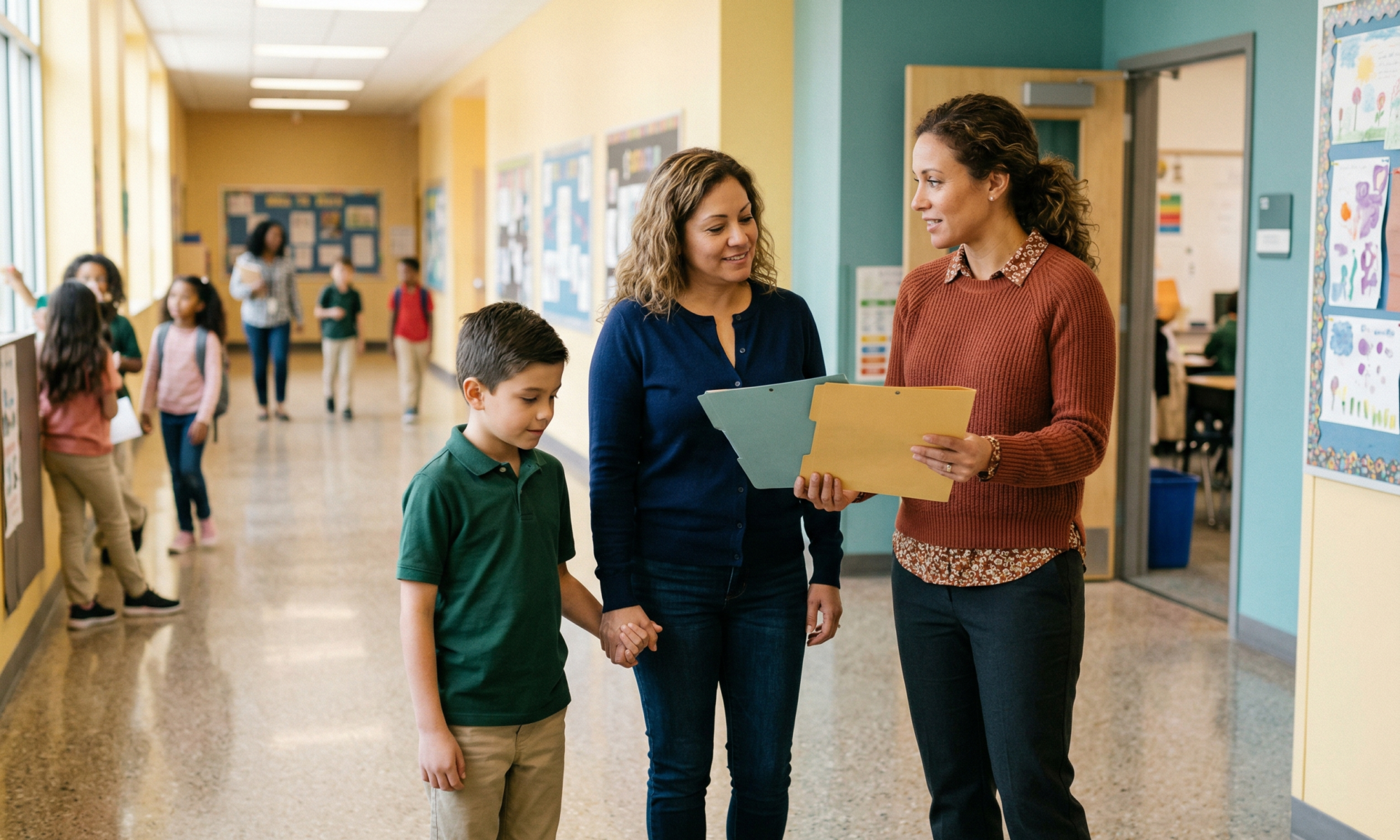
Parent, child, and education advocate talking through support options in a bright school hallway

Quick answer: An IEP and a 504 plan are not the same thing. An IEP is for students who need specialized instruction under IDEA. A 504 plan is for students with a disability who need accommodations so they can access school without discrimination.

If your child needs instruction that is specially designed, an IEP may be the better fit. If your child mainly needs classroom accommodations or access supports, a 504 plan may make more sense.

Key takeaways

  • An IEP can include specialized instruction, goals, services, and accommodations.
  • A 504 plan usually focuses on accommodations and access.
  • The right question is not which plan sounds better. It is which plan actually matches your child’s needs.
  • If the school keeps steering you toward one option without clear explanation, ask what data supports that choice.

IEP vs. 504 plan in Florida at a glance

Question IEP 504 Plan
What law is it tied to? IDEA Section 504
Who is it for? Students who qualify for special education and need specialized instruction Students with a disability who need accommodations or access supports
Can it include goals and services? Yes Usually accommodations only
Does it require formal team review? Yes There should still be a school process, but it usually looks less formal

When an IEP is usually the better fit

An IEP is usually the better fit when your child needs instruction that is different from what general education alone can provide. That could mean reading intervention, speech services, behavior support, specialized goals, or a service plan that needs to be monitored over time.

If your child needs more than seat changes, extra time, or teacher reminders, it is worth asking whether the school is treating an IEP issue like a 504 issue. A 504 plan can be helpful, but it is not supposed to stand in for special education when special education is what the student actually needs.

If you are still trying to get clear on the purpose of the special education process, this page on what an IEP is supposed to do is a good starting point.

When a 504 plan may be enough

A 504 plan may be enough when your child can keep up with the curriculum but needs access supports. Think extra time, testing accommodations, movement breaks, preferential seating, medical supports, or classroom changes that remove barriers without changing the instruction itself.

That is why a lot of parents first learn about 504 plans when ADHD, anxiety, health needs, or executive functioning concerns start affecting school access. If that sounds familiar, you may also want to read our Florida 504 plan guide.

What schools sometimes get wrong

Schools do not always explain the difference clearly. Sometimes they talk like the IEP and the 504 plan are just two versions of the same thing. They are not.

Parents also hear this a lot: “Let’s just do a 504 first and see how it goes.” Sometimes that is reasonable. Sometimes it is a delay tactic because the school does not want to start a full evaluation or a special education eligibility process.

If your child is struggling in a big way and the school keeps coming back to basic classroom accommodations, ask why. Ask what evaluation data they are using. Ask whether the concern is access only or whether your child also needs specially designed instruction. Ask what problem the school thinks the 504 plan will solve.

How to decide which one fits your child

Start with this question: does your child need instructional support that must be designed, delivered, and monitored in a more formal way? If the answer may be yes, push the conversation beyond accommodations alone.

Next, look at how the problem shows up:

  • Is your child failing to access instruction because of attention, health, mobility, or regulation issues?
  • Or is your child unable to make progress without specialized teaching, therapy, or behavior intervention?
  • Do classroom supports help somewhat, or are the skill gaps still widening?

If the school has not evaluated yet, you may also want to review what happens at an eligibility meeting. That helps parents understand how the school should move from concern to evaluation to a real decision.

Common mistakes parents make

  • Choosing the plan that sounds easier. Easier is not always better if it does not match the need.
  • Focusing only on labels. The real question is what support your child will get and whether it is enough.
  • Skipping evaluation questions. If the school has limited data, the plan choice may be weak from the start.
  • Assuming a 504 plan is a lesser version of an IEP. They are different tools for different kinds of needs.

FAQ

Can a child move from a 504 plan to an IEP?

Yes. If accommodations are not enough and the child needs specialized instruction, a special education evaluation may be the next step.

Can a child with ADHD have an IEP instead of a 504 plan?

Yes, if the child qualifies for special education and needs specially designed instruction, not just accommodations.

Does Florida change the basic difference between an IEP and a 504 plan?

No. Florida still follows the basic federal framework. The core question stays the same: what kind of support does your child actually need?

Not sure which path fits your child?

If the school is pushing one option and your gut says something still does not add up, that is worth slowing down for. The right plan should match the real need, not just the easiest paperwork path.

Book a free consultation

We can look at the records, the school response, and what support makes the most sense for your child.

Educational information only. Not legal advice.

The IEP Is in Effect. Now What? How to Track Services, Progress, and Follow-Through

Parent following up on IEP services from home with notes and a calendar

Quick answer: Once the IEP is in effect, your job shifts from meeting prep to follow-through. You want to confirm the final plan matches what was agreed to, track whether services and accommodations are actually happening, and ask for data before small gaps turn into bigger problems.

A signed IEP does not fix anything by itself. It only helps your child when the school puts the plan into practice and you can see that progress is happening.

Key takeaways

  • Get the final IEP and read it again. Do not assume the final version matches the meeting conversation.
  • Track services, accommodations, and progress in a simple way you can keep up with.
  • Ask for data when goals sound good on paper but daily school life still looks off.
  • Put concerns in writing early so there is a record if follow-through slips.

The first thing to do after the meeting

Read the final IEP once it arrives. Not quickly. Slowly. Compare it to what you thought the team agreed to in the room. This is the moment when parents sometimes catch wording that changed, supports that got softened, or details that were never clearly added in the first place.

Look at the goals. Look at the service minutes. Look at accommodations, behavior supports, and progress reporting. If anything feels different from what was discussed, flag it right away.

If you need a reminder on how team decisions are supposed to happen, it helps to go back to who creates and approves the IEP. That post can help you separate a true team decision from language that got pushed through without enough discussion.

What IEP implementation should look like

Good implementation is not mysterious. If the IEP says your child gets specialized instruction, speech, behavior support, or classroom accommodations, you should be able to see signs that those things are actually happening. Maybe you hear about it from staff. Maybe you see it in work samples. Maybe progress reports make sense. Maybe your child is telling you the support is finally showing up.

Bad implementation usually feels foggy. You keep hearing that things are “being addressed,” but no one can tell you when, how often, by whom, or whether it is helping. Your child still comes home overwhelmed. Work is still being sent home without supports. Behavior problems keep repeating. The plan exists, but daily school life looks the same.

A simple way to track services and accommodations

You do not need a fancy spreadsheet. Start with a plain tracker you can keep updated for a few weeks at a time. Make a short list of the supports that matter most right now. Then note what you are actually seeing.

  • What service or support should be happening?
  • How often is it supposed to happen?
  • What signs have you seen that it is happening?
  • What signs tell you it may not be happening consistently?
  • What data or explanation do you still need from school?

This is where many families realize the issue is not only the IEP itself. Sometimes the real problem is weak follow-through. Other times the services are happening, but the goals were never strong enough to begin with. If you are still working out whether the plan makes sense, go back to what the purpose of an IEP is and compare that standard to the plan sitting in front of you.

What to do when progress feels slow

Slow progress does not always mean the school is doing nothing. But it does mean you need more information. Ask what data the team is using to measure progress. Ask what the baseline was. Ask how often the goal is being reviewed. Ask what the team will change if the current approach is not working.

Do not let vague reassurance replace data. If the response sounds like “we think your child is improving,” follow up with “what are you using to measure that?” If the answer is still unclear, ask for a meeting or written explanation.

And look at patterns outside the progress report too. Is homework still a disaster every night? Is behavior still being reported the same way? Is your child still losing access to the general education setting for reasons the IEP was supposed to address? Real progress usually shows up in daily life, not just in a checked box.

When to put your concerns in writing

Early. Not after three more months of frustration. Not once everyone is defensive. Early.

If something feels off, send a short parent email. Keep it simple. Describe the concern, the part of the IEP you are referring to, and the clarification or next step you want. Written follow-up matters because it creates a record. It also gives the school a fair chance to respond before the problem grows.

Your message does not need to sound formal. It can be direct and calm. Something like: “I want to follow up on the reading support in the IEP. We are still seeing daily struggles at home, and I would like to understand how services are being delivered and what progress data the team is using right now.”

Signs the IEP may not be working as written

  • Your child is still not receiving listed accommodations consistently.
  • You cannot get a clear answer about who is delivering a service.
  • Progress reports are vague or do not match what you are seeing.
  • The same issue keeps coming up, but no one proposes a change in support.
  • School staff treat the IEP like a file on record, not a plan that should guide the day.

If the IEP itself was weak from the start, this can happen fast. That is one reason IEP meeting prep matters so much. If you have another meeting coming up, use this IEP meeting checklist to go in with clearer priorities.

Common mistakes parents make after the meeting

  • Assuming the signed plan will run itself. It will not.
  • Waiting too long to speak up. Small problems are easier to fix when you address them early.
  • Tracking everything and then burning out. Focus on the two or three supports that matter most right now.
  • Accepting progress language without data. Ask how progress is measured and what the team will do if the child is not moving forward.

FAQ

How soon should I expect services to start?

The answer can depend on what was added, but you should not be left guessing. Ask when each service or support will begin and who is responsible for it.

What if my child says the accommodations are not happening?

Take it seriously and ask follow-up questions. Children do not always describe the problem perfectly, but they usually know when daily school life does not match what adults promised.

What if the school says they are implementing the IEP but I do not see progress?

Then the next question is whether the supports are strong enough and whether the goals are appropriate. Implementation and quality both matter.

Need help reviewing what happened after the meeting?

If the IEP is technically in place but school still feels messy, unclear, or stalled, we can help you sort out whether the problem is implementation, weak drafting, or both.

Book a free consultation

We can review the plan, the follow-through, and the next step that makes the most sense.

Educational information only. Not legal advice.

Educational Consulting

educational consulting

Educational Consulting | My Educational Solutions, a local company, provides expert educational consulting, advocacy, plans and more. Contact us today for a free assessment.


Educational Consulting | Expert Consulting


One interesting question about educational consulting and advocacy is: What services do educational consultants and advocates provide?


Educational consulting and advocacy involves working with families to ensure that their child is receiving the best possible education and support. Educational consultants and advocates provide a range of services to families, including educational assessments, school placement services, and advocacy services.


One service that educational consultants and advocates provide is educational assessments. These assessments are used to identify a student’s strengths and weaknesses and to determine the best educational approach for that student. An educational consultant or advocate may administer these assessments themselves, or they may refer families to a specialist for testing.


Another service that educational consultants and advocates provide is school placement services. This involves helping families find the best school for their child based on their unique needs and circumstances. An educational consultant or advocate may provide families with information about different schools and programs, and may help them navigate the application and enrollment process.


In addition to educational assessments and school placement services, educational consultants and advocates also provide advocacy services. This involves working with families to ensure that their child is receiving appropriate accommodations and services in school. An educational consultant or advocate may attend meetings with school personnel, help families understand their rights under the law, and provide support and guidance throughout the advocacy process.


Overall, the services provided by educational consultants and advocates are designed to help families navigate the complex world of education and to ensure that their child is receiving the support and services they need to succeed in school. Whether it’s through educational assessments, school placement services, or advocacy services, educational consultants and advocates can make a significant difference in the lives of students and their families.


Educational Consulting | Experienced Assistance


Services:

Individualized Education Plans
Advocacy Services
Educational Consulting
IEP/504 Plan Advocacy
Special Needs Advocacy
Assisting Students with Special Needs

FREE 15 Minute Consultation
Video/Phone Consultation
Meeting the unique needs of each student
Assisting in providing inclusive environments for students with special needs


Call: 954-751-2300


Visit our website and contact us today.

A Parent’s Critical Role in Their Child’s IEP 

Boy with Special Needs


Being a parent- period- is a huge job, but being a parent-advocate  for a child with special needs, can feel like a monumental task. The goal of My Educational Solutions is to make the job of parent advocacy a bit simpler, a bit easier and a whole lot more accessible to your average parent. It is my hope that what I have learned over the course of many years in this arena, will benefit both you and your child. TO my core, I hope the information and strategies I share with you in this article will save you lots of time, arguments and heartache. 

Parent Participation and involvement is a major safe keeping parents are guaranteed through the Individuals with Disabilities Education Act (IDEA). IDEA provides a strong foundation and mandate for parent involvement. IDEA states:

“Almost 30 years of research and experience has demonstrated that the education of children with disabilities can be made more effective by strengthening the role and responsibility of parents and ensuring that families have meaningful opportunities to participate in the education of their children at school and at home.”

Your participation in educational decisions for YOUR child is critically important- this importance is backed by research that cites the benefit AND a federal law that acknowledges the benefit and both ensures and protects your participation. However, there might be times when you are not treated as you should be- which is an EQUAL MEMBER of your child’s IEP Team. You might experience a time where you feel that your input wasn’t fully captured or recorded as you said it. There might be times where you feel left out all together, or uncounted.

The required IEP team members are a special education teacher, a general education teacher, a representative of the public agency (could be principal, district representative, staffing specialist), an individual who can determine the instructional implications of evaluation results, and the student when appropriate. If your child is under 18, you have the ultimate authority whether or not they attend the meeting, though schools will strongly encourage the students participation from 14 years of age and older. 

The team can also include other individuals who have knowledge or special expertise regarding your child. You, as well as the school system, can invite anyone that has knowledge or special expertise about your child, such as an outside therapist, advocate, friend or grandparent. The district might invite an Assistive Technology Specialist, a Behavior Specialist, someone they have contracted for a specific purpose related to your child or someone from the compliance office. Also let’s insert section 7 after the intro. And see how that looks., YOU are an equal member of your child’s IEP team. No members input is “more important” than another. 

IDEA states specific entitlements to parents to ensure parents are given a fair opportunity to participate in decisions that impact how their child will receive special education services. Without these protections it would be impossible for parents to effectively advocate.

Understanding the major principles of IDEA will help guide your understanding of IEP’s, one cannot exist separate from the other. IDEA is what regulates what must be in the IEP and what schools must do, from the time they have notice or a suspicion that a student has a disability through graduation. 

What is Effective Parent Advocacy?


Effective Parent Advocates DO NOT assert rights that they do not have and they are able to focus on the BIG issues that need to be addressed and advocate effectively within the framework of what their child’s entitlements are, which truly are plentiful. 

Each states regulations and rules must be in accordance with Federal Law IDEA and individual districts policies and procedures are only approved by the state Department of Education if the language used reflects what IDEA mandates and in no uncertain terms. Therefore, if you move from one state or district to another with an IEP, your child is entitled to comparable services. 

There are other bodies of law that protect students with disabilities in public programs and in some private programs- all students with disabilities are protected by anti discrimination law Section 504 and civil right law the Americans With Disabilities Act. 

The Parent Input Section 


The IEP Team will ask the parent to provide their input at some point in every IEP Team Meeting. There is  an actual designated section for this in every IEP. The Parent Input Section is critically important, it is your chance to document your voice in the IEP Document. But parent must understand that there participation extends beyond the Parent Input section, and that they are equal IEP team members. Parents can and should participate in all parts of the IEP document, not just the parent input section. 

AS you go through each of the 5 IEP Domains and reflect on your child’s strengths, weakness, and the impact of their disability- it’s essential that where you have input – that you contribute that input within the Present Levels of Performance section of each Domain. Please give input that relates directly to the domain in question and it’s most helpful to share observations about your child that you have seen across settings- not only in your relationship with your child.

YOU! Yes, You are A Parent Advocate!

YOU are a parent advocate. Successful parent advocates are armed with information and know how to navigate IEP meetings with strength and class. When a parent advocate enters an IEP meeting they are tasked with the great responsibility of advocating for their child- their baby (and yes that’s your baby whether she is 2 or 20)- and they have the emotions involved that no other team member brings to the IEP table. 

You are at a disadvantage in some regards- you are not in the school observing your son like the rest of the participants have been, you are not in the classroom teaching your child everyday. You also didn’t get to have conversations with the team prior to the meeting. You are in a meeting where professionals are presenting to you about your child- the one that you know the most about and feel the most for. And they are sometimes presenting in a matter of fact way, 

“according to the data…”, “and in this area your child is in the second percentile” “he is not able to…” “she cannot focus on an academic ask for more than 5m” etc …. it can feel very cut and dry but this is the way that many teams have been trained to dissipate information in IEP meetings.

Parent advocates have the chance to come into meetings and bring a balance to it all and bring some human-ness back into the IEP meeting and simultaneously call for data collection and data driven goals and all other assurances. 

I want you to know that when you go into the meeting, yes you are a PARENT but I want you to also think of yourself as a professional advocate – A Parent Advocate- and behave in a professional manner as if you were representing a client that hired you to go to the meeting. If you were hired to represent a parent at a meeting where you were paid to attend,

You would probably do a few things 

    • You would come to the meeting prepared- knowing your goals and what your state administrative code has to say in relation to the goals you have set AND 
    • You would behave in a firm, friendly and professional manner 
    • You would also know what to do when the team disagrees with you and you disagree with the teams decision- you wouldn’t argue more or spend hours writing emails that get no response- you would take action as a professional 

Myself and other highly effective advocates that get results at meetings in cases where parents were not able to get results prior to hiring us, distinguish ourselves in a few key ways AND as a Parent Advocate, I want you to do that too.

To be an effective parent advocate, it’s not how loud you scream, how many emails you send on behalf of your child, or how many compelling arguments you are able to make about why the schools should embrace your proposed action or idea.

Effective advocacy instead is,

    • Knowing your rights- what you are entitled to and what you are not entitled to, 
    • Setting clear goals for your meetings and having a strategy in getting there
    • And a plan of what you will do if the team members say “NO”

In summation, the difference between a parent attending an IEP meeting and a Parent Advocate is a level of knowledge, professionalism, and the demeanor that comes with being taken seriously in a meeting.

The Value of Inclusive Education for All Students


The Value of Inclusive Education for All Students

Inclusive Education and successful inclusive schools are not just good for some students, it’s practice that’s good for all students. Time and time again we have seen that the same principles that make inclusive education work for students with disabilities, provide other students in the very same classroom with benefit. Being exposed to diverse ways of thinking and diverse learning styles prepares students for life after school. At the very core of school life is the focus on preparing students for life after school. There is no separate class of life after school, therefore, separate classrooms should only be used when absolutely necessary and for an interim period with specific purposes and goals. When a student is in a more restrictive environment the active goal of the school based team should be to provide the student with interventions and skills that allow him or her to return as promptly as possible to their peers and to greater exposure and access to the curriculum.

Universal design in education gives students with disabilities access in a natural and inclusive manner, but also is evidence based in reaching and teaching all students- let’s face it, we all learn differently and hold areas of weakness. Children learn compassion, empathy and go from simply accepting disability to embracing the inclusion of all members of their school. Inclusive Education puts in perspective that there is not a set standard of what intelligence is, that intelligence comes in many different forms and if we can appreciate what someone has to bring to the table and integrate that strength into the classroom, we are all better for it. This way of thinking helps promote healthy self esteem and self concept for all students. The idea is that one must not meet a certain standard or first be like others to be included. This puts things in perspective for other minority groups and makes it easier for students at large to embrace a world of differences from religious, to ethnic to politically diverse views.

Students with disabilities that learn in regular education classrooms often have IEP’s in place that call for collaborative efforts between the general education teacher and the special education teacher, this has been shown to have a benefit for ALL classroom learners, as the SPED teacher will often facilitate differentiated instruction in classroom centers and contributes learning materials and thinking strategies that benefit regular education struggling learners to the gifted learner. Modeling of social skills and coping strategies for emotional regulation that are proactively modeled in the inclusive classroom, are great for typical students to witness and be a part of. If we are honest, we all need mindfulness, positive self talk and better coping strategies for when life gets hard. One to one aides assigned to an IEP student, are often a great help to the class as a whole in facilitating organized small and whole group activities. The regular consultation that special education and regular education teachers partake in to make inclusive classrooms successful, improves learning outcomes for everyone. Numerous studies have shown the benefit of peer modeling/peer tutoring in the regular education classroom and that it’s serves as a beneficial practice for both the student mentor and the mentee. When we teach something to someone, we internalize and expand upon that skill ourselves.

The most intangible and meaningful aspect of inclusive education is the invaluable life lesson it teaches: that we are all counted for, included, and the message that schools have the chance to send all students and teachers- that there are no “others” in our school.

It’s critical to understand that inclusive education is NOT simply about students with and without disabilities sharing the same physical space. Inclusive education must be viewed by school communities as more than just a legal mandate*, but a venture of the heart.

When I attended a school holiday music performance for my daughter, Arielle, I witnessed an “inclusive” but divided stage and truthfully it made me uncomfortable. The self contained class that pushes into music and other special area classes was stationed on one side of the stage with their aide and the rest of the students, including my daughter, were together. I didn’t understand exactly why this practice was in place, other than it was likely always the way that things had be done- an age old practice that carried over. The subliminal message to other students in my daughter’s class was, “they are here, but they really aren’t a part of our class”. I know that adults that carry out these antiquated practices are not doing so to intentionally brainwash children to believe that they are separate and superior to their disabled peers, but yet and still this is the outcome. What I would rather have seen would have been that the six children that pushed into Arielle’s music class were placed next to role model students and that the aide stood back and provided support when needed or modeled for the children that were familiar with her face to the side of the music teacher who was directing from below the podium.

While successful inclusive education takes more upfront effort, planning and creativity from all supporting adults, it is certainly worth the effort for all students.

*The Individuals with Disabilities Education Act ensure students with disabilities are education in their least restrictive environment. Go to the US Department of Educations website to read about your child’s entitlement to a Free Appropriate Education.

Florida School’s Reopening and School Choice

Florida School’s Reopening and School Choice

Florida Schools Reopening and School Choice


Parents, clients, potential clients and professional colleagues have been contacting us with lots of questions and also asking for advice in making decisions about what to do with their children’s education come fall. Surveys have been sent out throughout districts statewide asking parents to select from a set of options. It is extremely important that parents and teachers fill out and submit these surveys so that school districts can properly plan for ALL students. Education Commissioner, Richard Corcoran ordered that all Florida public schools must reopen their campuses in August and offer five days a week of brick and mortar education as an option. This DOES NOT mean that all students will have no other option through the public school system but to go to brick and mortar school five days a week. Most districts throughout the state of Florida have already issued Reopening Plans that include the following options, 


  1. Hybrid Model: Online and In School (2-3 days in school per week with alternating cohorts)
  2. In School Learning- full time available for special populations, such as students in self contained classes where it is presumed the most complex learners to reach online are. 
  3. e-learning full time- any parent can make this selection, including parents that have students with IEP’s in self contained classrooms or special schools all day 
  4. Florida Virtual School, which existed before school closures (totally separate from e-learning which will be provided by and through the school). 
  5. Some districts have their own online school Magnet Program, Dade County is one district that does,  Miami Dade Online- abbreviated to MDO. 

AND- if those are not enough options for parents, here are others to think about,

  1. Withdraw your child from the public school system AND register him/her as a home education student with your districts home education office. This option has always been available to parents and should be considered thoroughly for all that it entails. Parents could either homeschool until they feel comfortable with returning their child to the public school system OR they could decide to continue home education as long as they see fit and apply for the Florida Gardiner Scholarship to use for the following year. The only requirement to homeschool is to register your child with your district as a home education student and to submit an annual report completed by a certified teacher or other qualified professional. You have the option for your child to participate in statewide testing, or not. AND you can contact the home education office to access any district curriculum to use in your home, should you choose to. Some home education students also choose to register part time at their home public school and receive ESE services and/or related services. 
  1. There are parents who are choosing to leave the public school system and to select a private school option that they believe is handling Covid related issues/CDC School Guidelines and education better than their districts proposed plan. There are private schools that are keeping classrooms very low, offering hybrid models and also offering virtual education full time. If you have applied for the FL McKay Scholarship, great! If not, go ahead and consider applying ASAP. The deadline is today to have the funds available towards your first private school installment. YOU CAN STILL apply after today, you would just miss the first pay out cycle and would have to wait for the next. If the private school you are considering has space and is a participating private school, it’s a non issue. To ensure you are eligible for McKay, check their official website cited below. Also, you MAY NOT use the Florida Gardiner Scholarship in conjunction with the Florida McKay Scholarship. If you aren’t eligible for McKay, but have the financial ability to do so, you could fund a private school placement yourself. Please be aware that when you leave the public school system your child is no longer entitled to the full scope of protections under the Individuals with Disabilities Act (IDEA), including the right to a Free Appropriate Public Education and to be educated in his or her Least Restrictive Environment. However, there are certain provisions under IDEA for parent elected private school placement students.
  1. If you have a child that is medically fragile, or that has a health condition that would make it life threatening OR of serious risk to contract Covid-19, you might be eligible for a Hospital Homebound placement. Hospital Homebound constitutes as a change of placement in your child’s IEP determined by a doctor’s order. This change of placement could involve IEP services delivered to the home and is worth considering. 

School choice, in general but even more so now, is an extremely personal decision for each parent to make and obviously each parent goes into that decision making process with their own set of considerations. Even before the virus, we had parents that chose home education for a whole host of reasons, including nutrition and religion. So to make a judgement is not appropriate, but we all obviously can have our opinion and can share our opinion without fear of being persecuted- I think we should be able to do that at least.

Fortunately, we are the parents of our own kids, so we make our own final call. There is a lot of complaining going on amongst teachers and parents alike about the reopening plans proposed. I, on the other hand, feel that we are lucky to have so many choices and that parents can exercise those choices. NOT every state or country has the options that we do. Consider that we are one of only three states that has a comparable program to the McKay Scholarship fund to begin with. Each choice comes with considerations individual to the student and family. Please realize that if you leave the Public School system and re-enter, the same IEP you left with will be in effect when you return. IEP’s DO NOT expire or terminate, contrary to what many schools misinform parents. The team would need to meet within thirty days of re-enrollment and follow the most recent IEP in the interim.

I believe children are paying a great price socially, emotionally, academically and communication wise – and for some students the impact of that is greater than others. We need to be respectful of each others choices and make ours based on careful consideration and our own gut instincts as parents. AS an advocate, parents are texting and calling me asking me what they should do. That is not my place. I can only share what I am doing (happy to if you contact me directly) and also help parents navigate ALL of the options available to them. I know that parents will make the right choice for their family and their unique set of circumstances so long as they have the information to do so.

Please contact us if you need more information about school choice in general, as well as school choice options in light of the pandemic. We are offering reduced fee, single session consultations all summer in an effort to help ALL parents. 

Please email info@myeducationalsolutions with any questions and feel free to comment below. 


Virtual Schooling AND IEP’s

Special Needs Online Education Coronavirus

We here at My Educational Solutions are hoping that you are healthy and maintaining some sense of peace during this very destabilizing time.

We are parents and we know the challenges of online education. WE know this is new for school districts and teachers. But we do feel that the greatest individuals effected by this period are our special education children and their parents. ALL kids have been effected in some way during this time- there have been lapses and losses, also gains- but we know that our families with special needs children are facing some of the most complex challenges. I just want to first acknowledge that before saying anything else.

What we provide and our still providing throughout the state of FL, is IEP advocacy and I can’t think of a time where it’s more needed. Parents hire advocates to help them navigate what is new terrain for them- eligibility, IEP’s, conflict resolution with schools- and now, online implementation of IEP services and accommodations.

We need to have fair expectations of schools during this period, yes.

We need to be reasonable, yes.

I get that and I am very sensitive to being fair, all the way around and during all times.

But fair doesn’t mean accepting anything, or allowing it to be continually  permissible during this extended period for students with disabilities to just totally get left behind.

I have the advantage of being one of the only advocates in the state of Florida that takes cases anywhere in the state of Florida, as well as in a few states outside of Florida. So, I get to see how many different districts are handling this time period and what can be done. I have seen districts that have proceeded with Response to Intervention using web learning. I have seen districts that are still convening all previously scheduled meetings, and districts that are refusing to meet all together. Some of my clients are in schools where all they are receiving in the form of virtual learning is a list of assignments to complete and turn in, no instruction. Others are listening to pre recorded videos teachers upload. Others are receiving direct instruction from ESE teachers and with other learners using programs such as Microsoft Teams and Zoom. I’m not sure the rhyme or reasons that some schools and districts responses to this extended period of school closures are so vastly different.

What I do know is that in FL statewide, school is not OUT, school is open, the physical school is closed but the responsibility of attending school and completing assignments is ON. These assignments are being entered as fourth semester grades and the idea is that students are being educated. When the public school makes an offering or makes programming available to students, it must be accessible to all students and there are ways to do that- syncing assistive technology with devices, providing prerecorded videos teaching IEP goals, going over concepts, etc. I don’t see any reason why students can’t receive the majority of IEP services and related services virtually. While in some cases, students might not want to participate or run away from the computer, offering is the first step and continuing to offer is the next step.

Many parents of students with IEP’s in the state of FL had preexisting IEP issues that didn’t just begin once school closures occurred. I expect that IEP’s that might not have been appropriate in the first place, weren’t serving students well even when they were in the school building. Now, services that didn’t work beforehand are still not working or not happening at all. Also, even with the most appropriate IEP’s, the IEP didn’t contemplate a change of placement from school to home- from exposure to peers to none.

Many accommodations can be provided online. Many services can as well. Good faith efforts can be made to help lessen this blow for children. Certainly districts can still meet virtually to amend IEP’s, conduct annuals and consider changes to IEP’s for when schools are back physically open. Most districts are doing so, but some are still refusing to meet at all.

We are happy to continue making requests on behalf of parents and advising parents during this time. Please take time to read this section of a statement published by the US Department of Education on March 21st, 2020,

“At the outset, OCR and OSERS must address a serious misunderstanding that has recently circulated within the educational community. As school districts nationwide take necessary steps to protect the health and safety of their students, many are moving to virtual or online education (distance instruction). Some educators, however, have been reluctant to provide any distance instruction because they believe that federal disability law presents insurmountable barriers to remote education. This is simply not true. We remind schools they should not opt to close or decline to provide distance instruction, at the expense of students, to address matters pertaining to services for students with disabilities. Rather, school systems must make local decisions that take into consideration the health, safety, and well-being of all their students and staff.”

The consensus among the US Department of Education, the Office of Civil Rights, the Office of Special Education and Rehabilitative Services (OSERS), COPAA (Counsel of Parents Advocates and Attorneys) is that as much as possible, school district should be doing whatever is possible to be done virtually to meet the unique needs of all students and continue to provide a quality education. This is reassuring to our advocacy efforts and consistent with the position that I have been taking with school teams on cases I am managing on behalf of parents.

Should you need additional help navigating online schooling and if you have questions specific to your child, please do not hesitate to reach out to us and take advantage of our reduced fee intake and consultation on IEP’s and Virtual Schooling. You can always email me directly,

krista@myeducationalsolutions.com.

Please stay tuned as we will be offering upcoming webinars on a variety of topics. We are also working on a Q&A Document for Advocacy and Virtual Education. Share with us your experiences both good and bad with virtual schooling and we will respond with help. We would love to hear positive stories too!

Thank you.

We provide IEP Advocacy and Educational Consultation Services in the following counties:

Alachua County, Hardee County, Okeechobee County
Baker County, Hendry County, Orange County
Bay County, Hernando County, Osceola County
Bradford County, Highlands County, Palm Beach County
Brevard County, Hillsborough County, Pasco County
Broward County, Holmes County, Pinellas County
Calhoun County, Indian River County, Polk County
Charlotte County, Jackson County, Putnam County
Citrus County, Jefferson County, Santa Rosa County
Clay County, Lafayette County, Sarasota County
Collier County, Lake County, Seminole County
Columbia County, Lee County, St. Johns County
DeSoto County, Leon County, St. Lucie County
Dixie County, Levy County, Sumter County
Duval County, Liberty County, Suwannee County
Escambia County, Madison County, Taylor County
Flagler County, Manatee County, Union County
Franklin County, Marion County, Volusia County
Gadsden County, Martin County, Wakulla County
Gilchrist County, Miami-Dade County, Walton County
Glades County, Monroe County, Washington County
Gulf County, Nassau County,
Hamilton County, Okaloosa County